Global demand for bare aluminum conductors continues to rise. According to Shanghai Metals Market (SMM) customs data, China‘s aluminum wire and cable exports reached 283,400 tonnes in the first half of 2026, up 109.76% year-on-year. Within this total, aluminum alloy bare conductors are growing at a faster pace than pure aluminum, driven by new applications in rail transit and renewable energy projects.
For procurement professionals, this signals a shift in conductor selection logic. Aluminum alloy conductors — particularly AAAC and ACAR — are no longer just a cost-driven substitute for copper. They are becoming the technical choice for specific application scenarios.
Before examining applications, it is important to distinguish between the two main categories.
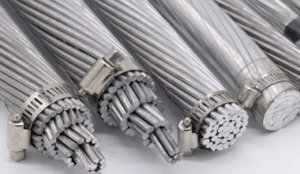
AAAC (All Aluminum Alloy Conductor) uses 6201-T81 aluminum-magnesium-silicon alloy wires for all strands, with no steel core. It is manufactured to ASTM B399 and IEC 62641 standards. AAAC offers higher strength than pure aluminum AAC and superior corrosion resistance compared to standard ACSR, with no steel core corrosion risk.
ACAR (Aluminum Conductor Alloy Reinforced) combines outer strands of 1350-H19 pure aluminum with a core of 6201-T81 aluminum alloy. It is manufactured to ASTM B524. ACAR provides higher conductivity than AAAC at equivalent strength, making it suitable for applications requiring both high conductivity and high strength.
Selection logic: For coastal or high-humidity environments requiring maximum corrosion resistance, AAAC is preferred. For large-span transmission lines requiring higher conductivity and strength balance, ACAR is the better option.
Aluminum alloy bare conductors are growing faster than pure aluminum for three reasons.
First, the copper-aluminum price ratio remains at historically high levels. The ratio exceeded 4.0 in 2026, well above the 3.5 substitution threshold recognized by the industry. This has made aluminum-based solutions economically compelling across a widening range of applications.
Second, CIGRE Technical Brochure 983, published in March 2026, provides a solid international technical foundation for evaluating high-temperature and advanced conductors — including AAAC — in new overhead line projects. The document notes that AAAC conductors, particularly alloy 1120, have consolidated over the past decade as an important design reference for overhead line projects.
Third, IEC 62641:2022 has consolidated the mechanical and electrical property requirements for aluminum and aluminum alloy wires used in concentric lay overhead conductors, providing a unified international standard framework for procurement specification.
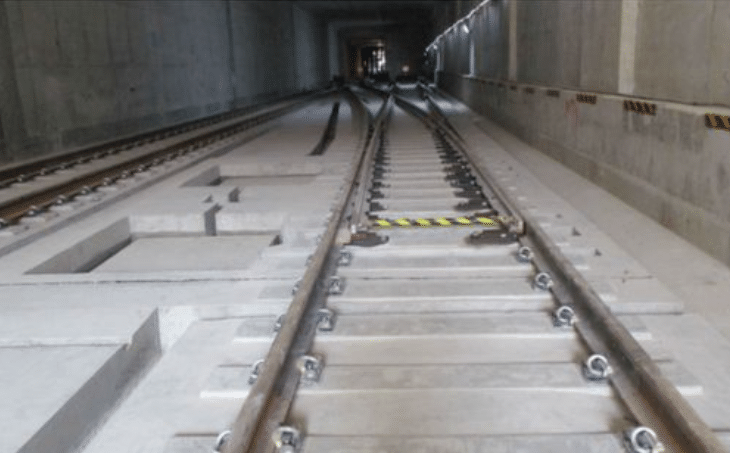
Electrified railway and urban rail transit projects require overhead lines connecting traction substations to the national grid. Traditionally, these feeders used copper or ACSR conductors. AAAC is now entering this space.
Project reference: In January 2026, Egypt’s state-owned Egyptian Electricity Transmission Company (EETC) signed a contract with Kuwait-based Kharafi National to connect nine traction power substations serving the country‘s high-speed electric rail project to the national grid at 220 kV. The project includes multiple lots with different conductor specifications. The first lot uses ACSR conductors. The sixth lot uses AAAC 405mm² conductors for the single-circuit overhead line connecting East Matrouh to traction substation TSS9.
The coexistence of ACSR and AAAC in the same project demonstrates that conductor selection is based on segment-specific conditions rather than a single preference. AAAC’s advantages in rail transit applications include higher strength-to-weight ratio for better sag characteristics, superior corrosion resistance for coastal and tunnel environments, and lower total cost compared to copper conductors.
Wind farm collector lines and transmission lines require conductors with fatigue resistance and corrosion resistance. In June 2026, NB/T 11979-2026, a Chinese technical guideline for aluminum alloy cables and accessories in wind turbine generator systems up to 35 kV, was published. Its implementation date is December 26, 2026. The guideline considers complex environments including inland, coastal, and high-altitude sites.
In an October 2026 project, the Jilin Dunhua 300 MW wind power 220 kV transmission project was approved, with a scope including replacement of busbars with 500mm² steel-reinforced heat-resistant aluminum alloy conductors and construction of 37.2 km of new overhead lines. This indicates that aluminum alloy conductors are entering practical application in wind power transmission projects.
Solar PV plants‘ collector lines and step-up station transmission lines represent a new application scenario for AAAC. Prysmian’s Voltalene Trunk cable, which received an innovation award at Intersolar 2026, features a reinforced insulation design with special aluminum alloy conductors specifically developed for overhead installation in solar PV plants.
Exporting aluminum alloy bare conductors requires compliance with destination market certification programs.
| Market | Certification | Applicable Standard |
| Saudi Arabia | SASO / SABER | Saudi standards for electrical conductors |
| Nigeria | SONCAP | Nigerian industrial standards |
| Indonesia | SNI | Standar Nasional Indonesia |
| Kenya | PVoC | Kenya Bureau of Standards |
| Egypt | GOEIC | Egyptian Organization for Standardization |
For projects in the Middle East and Africa, SASO, SONCAP, and SNI certifications are mandatory for customs clearance. Procurement professionals should confirm that suppliers can provide the required certification documents before shipment.
Q1: AAAC vs ACSR for railway projects — which is better?
It depends on the specific segment. AAAC offers better corrosion resistance and lighter weight, making it suitable for coastal and high-humidity segments. ACSR offers higher tensile strength, making it suitable for long spans. The Egypt high-speed rail project used both conductors in different lots.
Q2: What is the export price composition of AAAC conductor?
A defensible AAAC quotation includes five components: LME aluminum spot price, alloy premium, drawing and stranding cost, certification and testing cost, and factory margin plus logistics. Request a line-item breakdown rather than a single total price.
Q3: Which conductor for solar farm overhead line?
AAAC is suitable for solar farm overhead collection lines. For high-altitude or high-UV regions, specify enhanced corrosion protection. ACAR is an alternative where higher conductivity is required.
Q4: What certification do I need for exporting aluminum conductors to Saudi Arabia?
SASO certification is required for customs clearance in Saudi Arabia. The certification involves product testing and conformity verification to ensure compliance with Saudi technical and safety standards.
Q5: When should I consider aluminum instead of copper?
Industry experience indicates that when the copper-aluminum price ratio exceeds 3.5, aluminum substitution becomes economically compelling. The ratio has remained above 4.0 in 2026.
CN Cable Group manufactures AAAC and ACAR bare conductors to ASTM B399, ASTM B524, and IEC 62641 standards. Our products are available with SASO, SONCAP, and SNI certification for Middle East and African markets.
For project-specific conductor selection support or certification documentation, contact us.
Tel: +86-371-6054 7601
WhatsApp: +8613598056591
Email: [email protected]