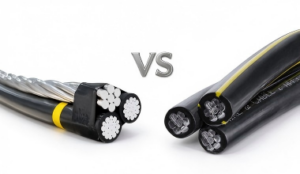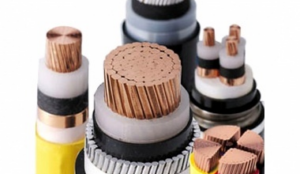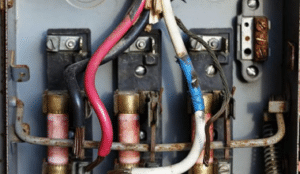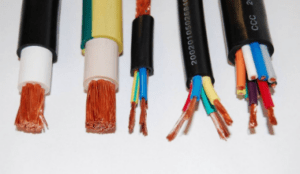
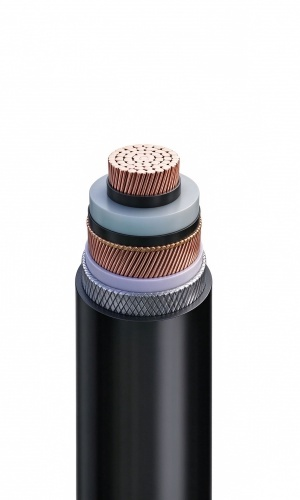
The screen bond at the termination suffered a thermal excursion, burning through the termination kit and insulation, eventually triggering an earth fault. The root cause? The cable was manufactured with steel wire armour (SWA) instead of aluminium or non-magnetic armour.
Similar incidents have been recorded in Chinese industry logs, with single-core steel tape armoured (STA) cables failing after 3 to 5 years. In those cases, the root cause was traced to procurement staff “subjectively changing the cable specification” because steel armour felt stronger and cheaper.
This is a common psychological trap. Mechanical strength and electromagnetic compatibility are two completely different dimensions. For single-core AC systems, choosing steel because it is “tougher” is a fatal mistake.
When alternating current flows through a single-core cable, it generates a time-varying magnetic field. If the armour is made of steel (a ferromagnetic material), this field induces eddy currents in the armour. These currents convert electrical energy into heat. The heat continuously degrades the insulation and eventually causes breakdown.
The failure is not immediate. It is a progressive thermal degradation process. In the 6.6kV case, it took 12 months. In the 3-to-5-year cases, the degradation was slower but inevitable.
Why multi-core cables are different: In a three-phase multi-core cable, the magnetic fields of the three phases cancel each other out. No net magnetic field means no eddy currents, which is why steel armour is safe for multi-core AC cables.
| Armour Type | Material | Magnetic Property | Suitable for Single-Core AC? | Risk of Eddy Current |
| AWA | Aluminium wire | Non-magnetic | Yes | None |
| SWA | Galvanized steel wire | Magnetic | No | High (heating & breakdown) |
| STA | Galvanized steel tape | Magnetic | No | High (heating & breakdown) |
The physics is not a matter of preference; it is codified in international standards. IEC 60502-2 explicitly requires that for single-core cables, the armour must be non-magnetic.
This means AWA (Aluminium Wire Armour) is the standard choice for single-core AC cables. If a project requires the mechanical strength of steel, non-magnetic stainless steel wire must be specified—not standard galvanized steel.
Given that the 6.6kV case and the Chinese logs both involve manufacturing or specification errors, buyers need verification methods.
Method 1: The Magnet Test (Most Practical)
Take a small piece of the exposed armour (or cut a small section). Bring a magnet close to it. If the magnet sticks, the armour is magnetic (SWA/STA) and must not be used for single-core AC. If it does not stick, it is non-magnetic (AWA or non-magnetic stainless steel) and is acceptable.
Method 2: Mill Test Certificate (MTC)
Require the supplier to provide a Material Test Certificate specifying the exact material grade. CN Cable Group supplies an MTC with every AWA-armoured cable, allowing buyers to verify the aluminium grade and supplier information.
| Verification Method | Stage Applicable | How to Execute | Basis for Judgment |
| Magnet Test | Sample / Delivery | Use a standard magnet | Sticks = magnetic (reject); No stick = non-magnetic (accept) |
| Material Certificate (MTC) | Pre-shipment | Check material grade on MTC | MTC explicitly states “Aluminium” or “Non-magnetic” |
| Visual Inspection | Delivery | Check armour colour and marking | Silver-grey wires are likely AWA; standard steel wires may have a zinc coating |
The failure in the 6.6kV case occurred in a single-core AC system. Steel armour is acceptable in two other scenarios:
1.Multi-core AC cables: The magnetic fields cancel out, eliminating eddy currents.
2.DC cables: Direct current produces a static magnetic field, which does not induce eddy currents.
If a single-core AC cable absolutely requires steel-level mechanical strength (e.g., for deep water or high-tension applications), non-magnetic stainless steel wire armour is the only compliant option. However, buyers should be aware of the trade-offs: non-magnetic stainless steel is significantly more expensive and typically has longer lead times than standard galvanized steel.
| Current Type | Core Configuration | Permitted Armour Types | Notes |
| AC | Single-core | AWA or Non-magnetic SWA only | Magnetic armour strictly prohibited |
| AC | Multi-core | AWA, SWA, or STA | Magnetic fields cancel out |
| DC | Single-core | AWA, SWA, or STA | Static magnetic field, no eddy currents |
| DC | Multi-core | AWA, SWA, or STA | Same as single-core DC |
Q1: Can I use SWA on a single-core cable?
No, not for AC systems. Steel is magnetic and will induce eddy currents, causing overheating and eventual breakdown. Single-core AC must use AWA or non-magnetic stainless steel.
Q2: Why can multi-core cables use steel armour?
In a three-phase multi-core cable, the magnetic fields of the three phases cancel each other out. With no net magnetic field, no eddy currents are generated.
Q3: How do I test if the armour is magnetic?
Use a standard magnet. If the magnet sticks to the armour, it is magnetic (SWA/STA) and unsuitable for single-core AC. If it does not stick, it is non-magnetic (AWA or non-magnetic stainless steel).
Q4: What does IEC 60502-2 say about single-core armour?
IEC 60502-2 explicitly requires that the armour of single-core cables must be made of non-magnetic material.
Q5: What is non-magnetic SWA and when should I use it?
Non-magnetic SWA uses stainless steel wires instead of galvanized steel. It is used when a single-core AC cable requires extremely high mechanical protection, but the cost is higher and lead times are typically longer than standard SWA.
Q6: How much more does AWA cost compared to SWA?
AWA is generally 12% to 20% more expensive than SWA for the same cross-section. However, for single-core AC systems, SWA is not a viable option, so the cost comparison is irrelevant—the choice is between AWA and non-magnetic stainless steel.
Have a specific MV cable project? Send us your system voltage, core configuration, and installation environment — our engineering teamhttps://www.cncablegroup.cn/contact-us/ will confirm the correct armour selection and provide the corresponding test reports.
Tel: +86-371-6054 7601
WhatsApp: +8613598056591
Email: [email protected]