Effective July 1, 2026, Norway‘s NEK 400:2026 introduces the most significant regulatory overhaul for low-voltage electrical installations in a decade — with direct and profound implications for cable selection, procurement strategy, and supply chain planning.
The single most impactful change in NEK 400:2026 is the effective phase-out of PVC cables. From July 1, 2026, all cables in electrical installations must be at least halogen-free of class Dca.
This is not a minor adjustment — it is, in the words of industry experts, “the most radical single change” in the new standard. PVC cables, which currently dominate the low-voltage cable market due to their low cost and established supply chains, will no longer be permitted in new Norwegian installations.
The Dca classification comes from the EU Construction Products Regulation (CPR), which classifies all building materials, including cables, based on their reaction to fire-. The classification system runs from Aca (best fire performance) to Fca (worst).
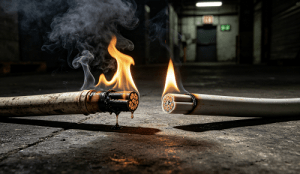
Why this matters: PVC cables only achieve fire class E. Fire class E cables emit smoke and corrosive gases during a fire, which can prevent evacuation, cause greater property damage, and increase the risk of life-threatening situations. In contrast, Dca cables burn more slowly, produce significantly less smoke, and release no corrosive gases — directly addressing the fact that most fire fatalities are caused by smoke and gases, not flames.
To understand the magnitude of this change, one must look at the previous standard. Under NEK 400 (the current edition), the regulations prescribe a minimum of fire class D but allow for many exceptions. In practice, this meant that fire class E (i.e., PVC cables) was routinely used in many Norwegian installations.
NEK 400:2026 eliminates these exceptions entirely. The normative requirement for Dca is now absolute — no exceptions, no workarounds. This is the regulatory equivalent of an earthquake for the Norwegian electrical industry.
1. Dimensioning and current-carrying capacity must be recalculated, as halogen-free cables have different thermal properties than PVC.
2. Clamping temperature limits must be reviewed.
3. Supply chains must pivot from PVC to halogen-free alternatives — a transition that will take time and create temporary shortages.
Edgar Karlsen, a member of NEK‘s technical committee for NEK 400 (NK64) and course instructor for the new standard, emphasizes that the changes are “not only about new formulations in the regulations, but about how the requirements are actually to be understood and applied in practice”. He warns that “uncertainty arises in the transitions: between design and execution, between requirements and documentation — and between established practice and new expectations. This is where the risk of errors increases”.
NEK 400:2026 does not exist in a vacuum. Its fire safety requirements are directly linked to the EU Construction Products Regulation (CPR) , which applies to cables used in buildings and civil engineering structures across Europe-.
Under CPR, cables are assigned a Euroclass rating based on their reaction to fire-. The most commercially relevant range falls between B2ca and Eca-. Norway, while not an EU member, is part of the European Economic Area (EEA) and aligns its technical regulations with European standards — meaning NEK 400:2026 is effectively harmonizing Norwegian requirements with the CPR framework.
For international buyers, the implication is clear: If Norway is mandating Dca as the minimum, it is only a matter of time before other European countries follow suit. Sweden has already introduced fire class D as a standard. The regulatory momentum is unmistakable.
While the cable fire safety changes are the most visible, the standard introduces several other significant updates that procurement professionals should be aware of:
These changes signal that the new standard is not just about fire safety — it is a comprehensive modernization of Norway‘s low-voltage electrical framework, responding to the energy transition, EV adoption, and digital infrastructure demands.
For procurement professionals sourcing low-voltage cables for European projects — or for any buyer looking to stay ahead of regulatory trends — the following checklist is essential:
1. Verify CPR Compliance
Ensure that your cable suppliers can provide third-party certified CPR test reports for Dca or higher classifications. Self-declarations are not sufficient for tender qualification in regulated markets.
2. Transition to Halogen-Free
PVC cables are no longer acceptable in Norway from July 1, 2026-. If your supply chain still relies on PVC, you need to qualify halogen-free alternatives immediately — not when the regulation takes effect.
3. Recalculate Current-Carrying Capacity
Halogen-free cables have different thermal characteristics than PVC. Your existing cable sizing calculations may no longer be valid. Consult with your supplier for updated ampacity tables.
4. Plan for Potential Supply Shortages
The transition from PVC to halogen-free will strain supply chains. Lead times may extend, and prices may rise as demand shifts. Procurement planning should account for these factors.
5. Look Beyond Norway
If you are bidding on projects in Sweden, Denmark, Finland, or other European markets, expect similar requirements to emerge. Norway is not an outlier — it is a regulatory pioneer.
6. Document Compliance
Ensure that your suppliers can provide full documentation for every cable shipment, including CPR classification certificates, test reports, and material declarations. Non-compliance can result in project delays or disqualification.
NEK 400:2026 is a regulatory mandate, but it is also a strategic opportunity. Buyers who proactively transition to halogen-free, Dca-compliant cables now will:
As Edgar Karlsen puts it: “Being up to date on NEK 400:2026 is not just about compliance, but about quality, safety and efficient implementation. Incorrect understanding can lead to rework, delays and increased costs”.
For cable buyers, the message is clear: The era of PVC is ending. The era of halogen-free, fire-safe cables is beginning. The time to act is now.
Contact us for halogen-free, Dca-compliant cable specifications, CPR certification documentation, and project-based quotations.
Tel: +86-371-60547601
WhatsApp : +86-13598056591
Email: [email protected]