The global industrial automation cable market was valued at approximately $6.4 billion in 2024 , growing to $6.9 billion in 2025, and is projected to reach $12.58 billion by 2033 at a CAGR of 7.8%.
Within this broader market, the industrial robot flexible cable segment—the cables that actually move with robotic arms—was estimated at $1.235 billion in 2025 and is projected to reach $2.231 billion by 2032, growing at a CAGR of 8.8%. The broader robot wiring harness and cables market was valued at $2.243 billion in 2025 and is forecast to reach $5.005 billion by 2032, with a CAGR of 12.3%. For reference, the global robotic cable market—a narrower definition—was valued at approximately $159 million in 2024 and is expected to reach $239 million by 2031.
Regionally, Asia-Pacific dominates the industrial robot cable market due to rapid industrialization and a growing focus on factory automation, particularly in China and India. North America and Europe follow, with the US tariff framework introduced in 2025 already prompting suppliers to reassess global sourcing strategies.
Every new robot installed means dozens of meters of cables that must endure continuous bending, torsion, and drag-chain movement. And unlike structural components, these cables operate under extreme repetitive motion stress and require replacement based on actual wear.
Here are the 5 differences every buyer must understand when sourcing cables for robotic applications.
Ordinary cables use coarse-stranded or even solid conductors, which fracture after limited bending cycles. Robot cables require IEC 60228 Class 6 ultra-fine stranded copper conductors, with individual wire diameters of 0.08–0.10mm — significantly finer than the 0.20–0.40mm found in ordinary cables. In a robot's continuous flexing environment, conductor fatigue is the primary failure mode — finer stranding distributes bending stress across more individual wires, dramatically extending fatigue life. When evaluating suppliers, check the conductor stranding specification: Class 6 (0.08–0.10mm) is the benchmark for dynamic robotic applications; Class 1 or Class 2 conductors are not suitable.
Ordinary cables are rated for several thousand to tens of thousands of bending cycles. Robot-grade cables must withstand a minimum of 5 to 10 million bending cycles, with premium products achieving over 20 million cycles. This difference directly determines maintenance frequency: the wrong cable may fail within months, while the right cable can support years of continuous operation. Request third-party laboratory bending test reports — not in-house self-test data. Focus on whether test conditions (bending radius, speed, load, cycle count) match your actual application. A supplier who cannot provide test data cannot guarantee performance.
Ordinary cables use PVC jackets, which soften, swell, and crack within weeks in oil-laden environments. Robot-grade cables use PUR or TPE jackets, offering superior oil resistance, abrasion resistance, and cut-through resistance. Robot work environments are filled with lubricants, coolants, and abrasive particles — the jacket is the cable's first line of defense. Confirm the jacket material specification: PUR > TPE > PVC. For industrial robot applications, specify at least TPE; for high-wear or high-oil environments, PUR is recommended.
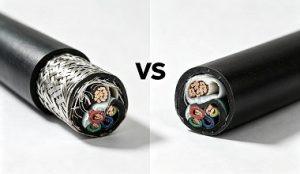
Ordinary signal cables have sparse shielding or none at all, leaving sensor and encoder signals vulnerable to EMI from VFDs, welding equipment, and high-power motors. Robot-grade signal cables feature high-density braided shielding, typically with ≥85% braid coverage. Encoder and feedback signals are the robot's "nervous system" — corrupted signals can cause positioning errors, oscillation, or even loss of control. Ask your supplier: Is the shielding braided or spiral (braided is superior)? What is the braid coverage percentage (85% or higher is the benchmark)?
Ordinary flexible cables are designed for bending in a single plane — the back-and-forth motion of a cable carrier. But robotic joints move in multi-axis rotation and compound torsion — the cable is not just bent, it is also twisted. A typical six-axis robot joint requires the cable to withstand ±360° torsion. Without torsional resistance, inner layers and outer sheath accumulate different stresses, leading to conductor fracture or insulation tearing. Quality robot cables are constructed through specialized stranding and lay patterns to withstand ±180° or greater torsion angles. Confirm whether the cable has been torsion-tested and request the test parameters — angle, speed, and cycle count. Leading robot manufacturers such as ABB, FANUC, and KUKA all require torsional testing as part of their cable qualification process.
Cables with identical specifications can have bending life differences of several times depending on material purity and process precision. Test reports matter more than spec sheets.
Flexible cables are only bending-tested; robot cables must also pass torsion testing. A flexible cable without torsion test data is not suitable for robotic joint applications.
Price is not the sole indicator, but cables priced significantly below market average will have performance compromises. Base decisions on test data, not on price or brand alone.
| Cable Type | Function | Selection Criteria | CN Cable Group Product Reference |
| Power Cable | Main power supply from control cabinet to robot | Current-carrying capacity; jacket abrasion resistance; rated 0.6/1kV | H07RN-F, Crane Cable, SOOW |
| Servo Cable | Connect servo drive to servo motor | Flexibility + shielding; immunity to VFD harmonics | VFD Cable |
| Encoder/Signal Cable | Transmit position, speed, torque feedback signals | Shielding density ≥85%; signal fidelity | CVV-S, LiYCY, Instrumentation Cable |
| Hybrid Cable | Power + signal + data in one cable | Cross-talk prevention between functional units | Customized Cables (available upon request) |
— Six-axis, collaborative, SCARA, AGV, or humanoid — each requires different cable combinations.
— Oil exposure? Cleanroom? High/low temperature? — determines jacket material.
— Conductor class, shielding density, bending life rating — determines product grade.
— One supplier for multiple cable types means unified standards, unified certification, and unified delivery.
For procurement professionals managing robot or automation projects, selecting the right cable is not a detail — it is a decision that directly impacts uptime, maintenance costs, and operational safety.
Tel: +86-371-60547601
WhatsApp: +8613598056591
Email: [email protected]