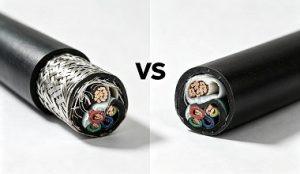
Supplier A quotes shielded cable at X USD/m, Supplier B quotes unshielded at 25-50% less. Same specification, price difference nearly half. Which one do you choose?
Here's a framework to help you decide.
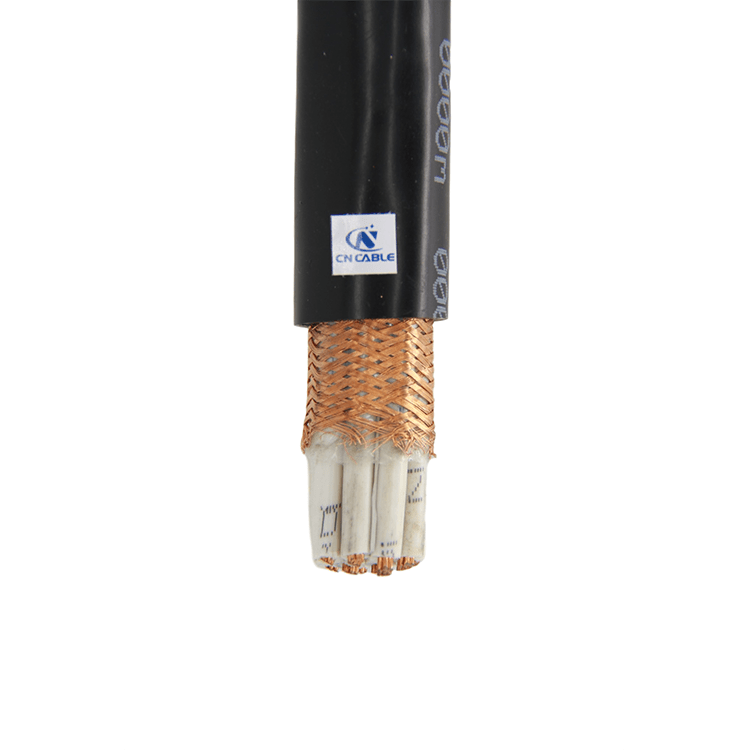
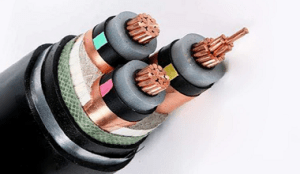
A shield is a conductive layer — typically copper braid or aluminium foil — wrapped around the insulated conductors. It serves two purposes:
1.Protects the cable from external interference — prevents electromagnetic interference (EMI) from corrupting signals
2.Contains interference from the cable itself — prevents the cable from radiating noise to nearby equipment
Control cables carry low-level signals — 4-20mA, thermocouple millivolt signals, or digital communications. A few volts of induced noise can completely swamp the signal.
Power cables carry hundreds or thousands of volts. Induced noise is negligible by comparison.
Analogue signals have a narrow operating range. A 4-20mA loop has only 16mA of variation. Thermocouple signals are measured in millivolts.
Even a small induced voltage — from a nearby motor cable, VFD, or welding transformer — can shift the reading by several milliamps or millivolts. The PLC interprets this as a real process change.
The control system receives false readings. A temperature sensor reads 50°C when the actual temperature is 120°C. A pressure transmitter sends 12mA when it should be 8mA — the PLC adjusts a valve incorrectly. Product quality suffers. Equipment may be damaged.
Variable frequency drives (VFDs) are a major source of electromagnetic interference. Their switching frequencies generate high-frequency noise that couples into adjacent cables.
VFDs produce both conducted and radiated EMI. The radiated component can couple into nearby control cables even without direct electrical contact. The noise appears as spikes on the control signal, causing erratic behaviour.
A real case from 2026: A lithium battery module production line with three 22kW VFDs experienced repeated IGBT module failures during commissioning, with thousands of yuan in losses each time. The root cause was traced to EMI coupling — signal cables and power cables running in the same cable tray, with improper grounding creating ground loops that amplified the interference. The fix: replacing unshielded signal cables with shielded versions and correcting the grounding scheme.
The longer the cable, the more interference it can pick up. The higher the voltage environment, the stronger the interfering fields.
IEEE research has documented the severity of this problem. In high-voltage substations, switching operations create intense transient electromagnetic fields that couple into nearby control cables. These transients can induce voltages high enough to damage electronic equipment.
Equipment misoperation, relay failures. In extreme cases, protection systems may fail to operate correctly during actual faults — creating a safety hazard.
Digital signals have only two states — on or off. The voltage range is wide (typically 24V DC ±20%). A small amount of induced noise is unlikely to change a logic state.
The signal-to-noise ratio is inherently high. The receiver is designed to accept a broad range of voltages as "high" or "low." Unless the interference is extreme, the digital signal remains readable.
Inside a control cabinet, cable runs are short and the metal enclosure provides natural shielding.
The short distance limits interference coupling. The grounded cabinet acts as a Faraday cage, attenuating external fields. The cable is surrounded by other grounded equipment that further reduces EMI exposure.
| Shield Type | Construction | Coverage | Best For | Limitations |
| Braid Shield | Tinned copper wire braided into a mesh | 70-95% | Low-frequency EMI, robotics, moving cables, cable carriers | Gaps allow high-frequency "leakage" above 100 MHz |
| Foil Shield | Aluminium tape wrapped or laminated | 100% | High-frequency interference, fixed installations, cost-sensitive projects | Brittle — breaks with repeated bending; not for moving cables |
| Combination Shield | Foil + braid double layer | 100% + braid | High-noise environments, VFD-dense areas, critical signals | Most expensive, largest diameter |
Foil + braid combination shield delivers the best overall protection. In VFD-intensive environments where both high-frequency and low-frequency noise are present, combination shielding is the most reliable choice.
| Criterion | Shielding Required | Shielding May Be Skipped |
| Signal type | Analogue, high-speed comms | Digital (switching) |
| Environment | VFDs, motors, welding, HV substation | Control cabinet, office, low noise |
| Cable run | >30 metres | <5 metres |
| Cable path | Same tray as power cables | Separate tray, short cabinet wiring |
The decision is simple:
Yes. Shielding adds material and manufacturing steps — typically 25-50% more than unshielded cable. But troubleshooting interference on an unshielded cable can cost far more in labour and downtime than the up-front saving.
In industrial environments, control cable shields are typically grounded at one end only (at the control panel side) to avoid ground loops. Double-end grounding may be required in high-frequency or high-voltage environments, but should be evaluated case by case.
Braid coverage density refers to the percentage of cable surface area covered by the copper braid. Higher density means better shielding effectiveness. Typically ≥80% is required; for critical signals, ≥90% is recommended. Suppliers should specify braid coverage density in their technical data sheets.
Request shielding effectiveness test reports or transfer impedance test reports from the supplier. Reliable suppliers should be able to provide third-party test reports. Also verify the shield material (tinned copper is better than bare copper) and braid density.
Fixed installations, high-frequency interference → choose foil shield (100% coverage, lower cost). Frequent bending, moving applications, cable carriers → choose braid shield (good flexibility, bend resistance). VFD-dense areas, strong EMI environments → choose combination shield.
CN Cable Group offers a full range of control cables covering all scenarios discussed in this article:
| Scenario | Recommended Product | Description | Link |
| Shielding required (analogue, VFD environment, long runs) | CVV-S Control Cable | Copper tape/wire braid shield, effective EMI protection | View Product |
| LiYCY Multi-core Control Cable | Shielded multi-core control cable, EMI resistant | View Product | |
| CY PVC (YSLCY) Control Cable | PVC insulated shielded flexible control cable | View Product | |
| Shielding not required (digital, short cabinet runs) | YY PVC Control Cable | Unshielded, suitable for low-interference environments | View Product |
| LiYY Control Cable | Unshielded multi-core, suitable for signal transmission | View Product | |
| Frequent bending/moving | SY Control Flexible Cable | Flexible construction, suitable for cable carriers and moving applications | View Product |
| Harsh industrial environments | CLX Type ITC/PLTC Armored | Armoured + shielded double protection | View Product |
Products comply with IEC 60502-1, GB/T 9330 and other standards, with customisation available upon request.
View full product catalogue:
https://www.cncablegroup.cn/products/