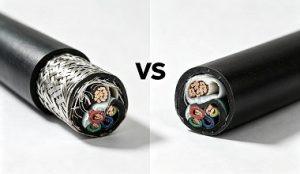
Rubber cable costs more than PVC. The question is: does your project actually need what rubber offers?
Here’s how to decide.
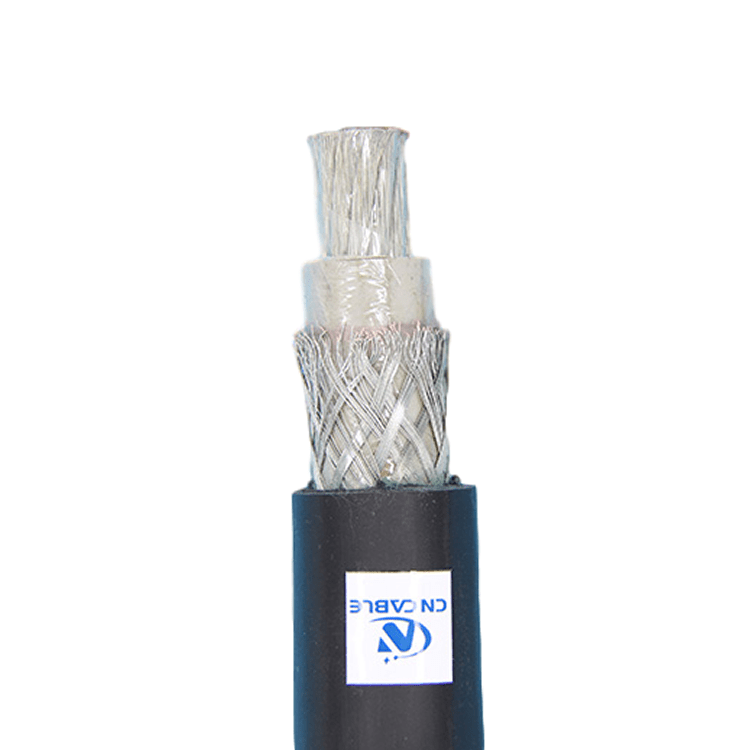
PVC is a thermoplastic. It’s rigid at room temperature, softens when heated, and becomes brittle when cold. It’s designed for fixed installations — cables that go into walls, conduits, or cable trays and stay there.
Rubber is an elastomer. It stays flexible across a wide temperature range, recovers after bending, and absorbs mechanical stress. It’s designed for applications where cables move, bend, flex, or are dragged.
One sentence: PVC is for cables that don’t move. Rubber is for cables that do.
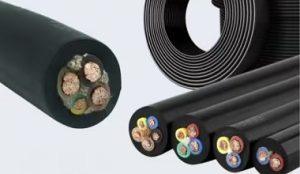
H07RN-F is the most common rubber cable standard in industrial applications (IEC 60245-4), with flexible rubber insulation and sheath designed for moving equipment, construction sites, and heavy-duty industrial use. The performance characteristics described below are based on this standard.
| Material | Continuous Operating Temp | Short-Circuit Temp | Current-Carrying Capacity |
| PVC | 70°C | 160°C | Baseline |
| Rubber (EPR/Neoprene) | 90°C | 200°C | Higher |
| XLPE | 90°C | 250°C | Higher |
PVC softens at 70°C and begins to degrade. Rubber (EPR) withstands 90°C continuously — a 20°C advantage over PVC. This means a rubber-insulated cable of the same conductor size carries more current safely than PVC. The short-circuit temperature gap is also significant: PVC breaks down at 160°C, while rubber withstands 200°C.
Procurement implication: For high-ampacity applications or installations in warm environments, rubber’s 90°C rating provides a genuine technical advantage over PVC’s 70°C limit.
Rubber generally has higher dielectric strength than PVC, meaning it can withstand higher voltage levels without insulation breakdown.
PVC insulation resistance is slightly lower than rubber. For low-voltage control and signal applications, PVC’s dielectric properties are usually adequate. For medium-voltage or high-reliability industrial installations, rubber’s superior dielectric performance is a factor worth considering.
Procurement implication: For applications where insulation integrity is critical (high-voltage circuits, safety-critical systems), rubber’s higher dielectric strength offers a margin of safety that PVC cannot match.
Rubber cables withstand tens of thousands of bending cycles without failure — H07RN-F cables are rated for dynamic applications, with bending radii as tight as 4× cable diameter in fixed installations and 6-8× in mobile use. The stranded conductor design distributes stress across multiple fine wires, significantly extending fatigue life.
PVC stiffens with repeated bending. Over time, it cracks, whitens, and fails. It is not designed for continuous movement.
Procurement implication: If your cable will bend more than once during its life, rubber is the safer choice. H07RN-F rubber cables, with fine-stranded Class 5 copper conductors and flexible rubber compounds, are specifically engineered for repeated flexing in cable carriers, reeling drums, and portable equipment.
Rubber with EPDM or chloroprene compounds operates reliably from -40°C to 90°C (special formulations down to -60°C). It stays flexible in freezing conditions and doesn’t become brittle.
PVC becomes brittle below -15°C and is prone to cracking. Low-temperature impact tests consistently show PVC failing while rubber compounds pass.
Procurement implication: For outdoor installations in cold climates — northern Europe, Canada, Russia, high-altitude sites — rubber is the only viable option. PVC cables may crack during winter installation or early service life.
Rubber — particularly chloroprene (neoprene) and EPDM compounds — resists mineral oils, acids, alkalis, UV, ozone, and abrasion. EPDM in particular has excellent resistance to heat, light, and ozone. Rubber cables are rated for harsh industrial environments, outdoor exposure, and ATEX zones.
PVC swells and degrades when exposed to oils and grease. Long-term UV exposure causes chalking and cracking. It is suitable for clean, indoor, fixed installations.
Procurement implication: If oil, grease, chemicals, or outdoor UV exposure are involved, rubber is required. The chloroprene sheath on H07RN-F cables is specifically formulated to resist oil and grease, which are common in industrial and workshop environments.
PVC insulation has a theoretical lifespan of 20-30 years in ideal conditions, but this shortens significantly in high-temperature environments — every 10°C rise above normal operating temperature more than halves the life. In hot areas such as kitchens, PVC life may drop to 15 years. Rubber (EPR) is rated for 25-35 years.
The aging mechanism also differs: PVC degrades through plasticizer migration and thermal breakdown, while rubber primarily ages through oxidation and ozone attack — which can be mitigated with EPDM compounds that resist ozone degradation.
Procurement implication: For long-life installations (>20 years), rubber (EPR) offers better long-term reliability than PVC, particularly in warm or chemically active environments. For short-term projects or fixed indoor applications, PVC’s 20-30 year rating is sufficient.
Rubber cable typically costs 1.5 to 2 times more than PVC cable for the same specification. EPR rubber compounds are more expensive than PVC compounds.
However, in demanding applications, rubber’s higher upfront cost is often recouped through longer service life and lower maintenance:
| Application Type | PVC | Rubber |
| Fixed indoor, no movement | 20-30 years | — |
| Mobile / dynamic applications | 18-24 months failure | 5-10 years service |
| Outdoor / harsh environment | Rapid degradation | Long-term reliability |
For short-term or fixed installations, PVC is cost-effective. For long-term, mobile, or harsh-environment applications, rubber often delivers lower total cost of ownership despite the higher purchase price. This is particularly true in industries like construction, mining, ports, and manufacturing — where cable failure means costly downtime and disruption.
Yes (frequent bending, dragging, reeling, cable carriers) → Rubber is required.
No (fixed inside walls, conduits, or trays) → Proceed to Step 2.
Outdoor exposure, oil/grease, extreme cold (< -15°C), mechanical stress, wet conditions → Rubber.
Clean, dry, indoor, temperature-controlled → Proceed to Step 3.
Long-term (>5 years) → Rubber — lower total cost over the cable’s life.
Short-term (<2 years) or one-off installation → PVC is adequate and cost-effective.
| Project Type | Recommended | Why |
| Mobile equipment, cranes, cable carriers | Rubber | Bending fatigue resistance, fine-stranded conductors |
| Outdoor, oil-exposed, harsh environments | Rubber | Weather, oil, UV resistance (EPDM/chloroprene) |
| Cold climates (< -15°C) | Rubber | Low-temperature flexibility down to -40°C |
| High-ampacity / high-temperature installations | Rubber | 90°C continuous rating vs PVC’s 70°C |
| Fixed indoor wiring, residential | PVC | Cost-effective, adequate for static use |
| Short-term temporary installations | PVC | Lower upfront cost |
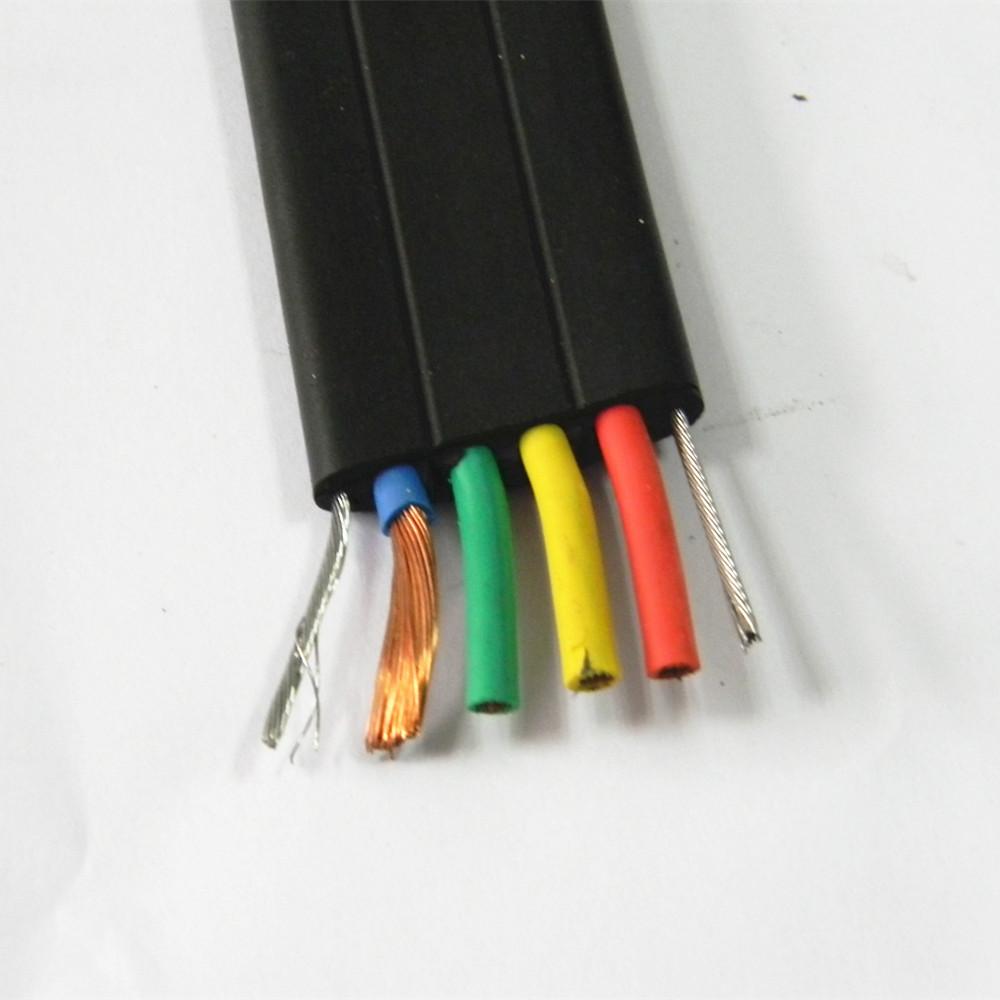
CN Cable Group manufactures H07RN-F rubber cables in accordance with IEC 60245-4 standards, with EPR insulation and chloroprene/CPE sheath.
For projects requiring rubber cables — or to confirm whether your application actually needs rubber — contact us for selection support.
Tel: +86-371-60547601
WhatsApp: +8613598056591
Email: [email protected]